Translate

Showing posts with label landlocked. Show all posts

Sunday, May 11, 2014

Grandmothers Unite!

Evidence that I believe in the sincerity and helpfulness of the office of Los Angeles County Supervisor Michael D. Antonovich is that I publish this blog under my own true name. My conviction is that if I cannot be above-board, it is not reasonable to expect Mr. Antonovich and his deputies to be open and transparent with us. And maybe they will see my fool’s courage as a challenge, and resolve to be equally daring. Also, finally, if we are honest and they turn out not to be, what a public relations coup for our side!

Me. Just kidding around! Not really grumpy.
Sometimes I remind myself of the grandmother who refuses to move out of a drug-infested neighborhood, and who faces the personal danger posed by the dealers who want nothing more than to shut her up. When I see that I am the only one using my own truthful name, it makes me a little nervous. Am I a fool? But then, Norm Hickling and Los Angeles County Supervisor Michael D. Antonovich are using their own truthful names on this blog, too, whether they want to or not.

I got these from the internet:

County of Los Angeles Supervisor Michael Dennis Antonovich

Our Benefactor, Norm Hickling
 Back in November 2013 when I began this blog my intention had been to relate several of my neighbors’ stories, but soon more and more of them began telling me that though they were willing to help out with photos and news notes, they desperately wished to remain anonymous. When I built a website for our neighborhood some years ago, one by one they all begged me not to publish pictures of their houses. Most humorous to me is the neighbor who tells me that he cannot be known because he has so much to lose, and I don’t—he wants to be sure never to have as little as I do!


It’s not as if my neighbors are unknown to the powers that are besieging us; of course those authorities know plenty about every one of us. But apparently many members of the Briggs Road Community fear that being landlocked for a decade is not the worst that can be done to them. I have no idea what worse offense Los Angeles County or other agencies may be contemplating against these good people, but I do have great respect for the creativity of the designers of this landlocking plan, whoever they may be.

You hear weird rumors about “other” depredations allegedly committed by our own supervisor. And when a member of the media chooses not to run our story, some folks explain that choice by suggesting that the newscasters and commentators are afraid that our own county officials would shut them down or even get them fired.

Miraculously, we are at a point now where officials on the staff of County of Los Angeles Supervisor Michael Antonovich appear to be working toward freeing our community. In a blogpost to follow I will list the actions we find so encouraging. Right now, my focus is on our community and its state of mind.

Our next task is to shift gears a bit and prepare to take on a share of the financial responsibility for the roads and river crossings for which we have been pleading. We never dreamed these would be free of charge. They never have been in the past but we will now be required to construct a better road and a better river crossing. Gone are the days when a bunch of guys could reassemble the culverts after a gully-washer with a tractor and a case of beer.

Formerly not such a big deal

One tiny step for a man; one giant step for Briggs Road

Some of our neighbors may be a little hesitant to join the effort. Post-traumatic stress disorder is working on all of us, and we don’t know what or whom to trust.

You can’t beat someone nearly senseless for ten long years and then expect him or her to jump bravely to her feet, fully functional. Given all that has happened, and how long it has been happening, it may take a moment for all of us to shake it off and adjust to a new reality—if in fact the new reality is really real, which is our constant concern these days.

But “they” are not really out to get us, are they? The trouble is that when there is as little explanation as there has been—as little believable explanation—people naturally assume the worst. That is a very typical response, and often a good survival tactic. I can’t imagine why Los Angeles County officials and State of California officials would not enthusiastically proffer reasonable explanations for whatever was their role in the landlocking of a neighborhood. We are hoping that as they think about it, they have realized that whatever reasons they once had, those reasons are no longer feasible. Maybe they will divulge old motives, or maybe we will never know what was behind ten long years of an excruciating commute—four or five miles of the worst dirt road anywhere, according to UPS and propane delivery drivers. I’ve driven many dirt roads shuttling my canoes all over the United States, and I have to agree.

It behooves county officials to lend extra compassionate support to this community, in the aftermath of Goliath pounding David into the ground mercilessly for ten long years. I would like to refrain from accusations, but we all know that urging Los Angeles County’s support, even advocacy, for this community is fully appropriate.

Norm Hickling has been delivering the good news that he and the rest of the staff of Los Angeles County Supervisor Michael D. Antonovich have been hard at work and reports a fair amount of progress. But we can’t quell this niggling fear that he will also say that we have just one more little obstacle to overcome. Then I will have to hear my conspiracy-theory-prone neighbors say, “See! I told you so!” to me, and I have no good comeback for that.

I just hope, please dear God and Los Angeles County Supervisor Michael D. Antonovich, that the last little obstacles are things that can, and really really will fall away. And that they really do! And then we all drive out to Soledad Canyon Road blowing kisses! Scattering roses! Calling out, “We love you Norm!”


We love you Norm! Do yourself proud. Do us right!

Thursday, March 20, 2014

Which Crossing is Okay?


We need a bridge!
            It’s time for another guessing game here on Save Briggs Road! Which of the river crossings shown below have escaped condemnation by the powers that be?

            All but one of the photographs below were taken in Soledad Canyon, not far from the location of our desired crossing.

      1. It is not unusual for a culvert-based crossing to wash out during a period of heavy rain. This photograph depicts the remains of such a crossing. Prior to the washout, what was the status of this crossing?


      2.  This bridge enjoys a bit of notoriety for its novel construction. It features the traditional culverts, with a garnish of railroad ties marinated in creosote. The crossing has gone the way of all such structures after a heavy storm, with the culverts slipping and rolling downriver, and the railroad ties steeping in the wet sand.


      3.  Is there such a thing as over-building a crossing?


4.  Here vehicles cross over the frothy flood via a railroad car bed. Note the safety railing at the sides.


5.  This picture was taken during construction of a culvert bridge, four days after its predecessor was wiped out. (We've been waiting almost ten years for the privilege.)


6.  Is it more environmentally sound to anchor the culverts in concrete, or is it better to allow the swollen river to push aside all obstructions? We know of a case where the river undermined a concrete barrier and left it buried forever at the river bottom.


Another View


Now for the scoring. If you judged only one of these bridges to be allowed to stand until the next flood, you get only one point, for not understanding how things work in Soledad Canyon.

In fact, however many of the bridges you judged to escape censure by the authorities, that is your score. Yes, the perfect score on our quiz is six. Not one of the photographs presented here represents a forbidden crossing.

What, then, constitutes a forbidden crossing? A crossing to be used by the residents of the Briggs Road Community is, by some strange definition, in violation of the edict set by the people-in-charge. We are not aware of any other type of crossing to run afoul of the authorities.

You may have noticed that I did not divulge the location of any of these bridges. That is because it is not our wish to have any of them or their descendants condemned. The point is this: What’s the Big Deal? If every one of these bridges is allowed to stand until Mother Nature takes it out, what is so special about a crossing accommodating the Briggs Road Community? Over the years we have cooperated in the creation of several such crossings, none worse than the worst on display here.

One last thought: Allowing the Briggs Road Community to cross the Santa Clara River benefits every single party involved in this struggle, be it a governmental agency or private interest—assuming that each is being honest about its intentions. I am not at liberty to spell out each of those benefits, but certainly there is no harm in suggesting what a bundle of good will and good press would settle on the shoulders of every involved member of Supervisor Michael D. Antonovich’s staff. 

It should be all right to point out that re-opening the much shorter access to Soledad Canyon Road takes our traffic off of the many more miles that run directly through Conservancy holdings. 

And surely there is no need to mention the importance of having a secure and reasonable access route for Briggs Road residents. That's only right.


Thursday, January 16, 2014

A Misleading Email

In September 2004, the month after Briggs Road residents were closed out of their homes by a private LLC landowner, one of our neighbors received an email reply to the question, “As the County did issue… Certificates of Compliance, doesn’t some right of access exist to the property owners?”

The reply appears to be replete with errors, which is surprising because it came from one of Michael D. Antonovich’s deputies, Paul Novak, who was Planning Director for the County of Los Angeles at the time.

Our copy of the email is barely legible. In the belief that our access difficulties would be short-lived, we did not retain digital copies of the email. All we have is this copy of a scan of the printout of the original.


Sorry. Perhaps it would be helpful to retype a portion.


Subj:      RE: Agua Dulce Homeowners
Date:     9/17/2004  9:20:38 AM Pacific Daylight Time
From:    PNovak@bos.co.la.ca.us
CC:       NHickling@bos.co.la.ca.us, …

One thing to bear in mind about the certificates of compliance is that they do not “confer” access. The certificates merely reflect a County determination that the property in question is a legal lot consistent with the State of California Subdivision Map Act (SMA). A legal lot does not necessarily have access—regrettably, there are many lots in the County and in other jurisdictions that do not have legal access.


I have read the 100 plus pages of the Subdivision Map Act of California, and I could find nothing that required a lot to have access for its map to be accepted as legal. What is required, though, is that the parcel meet the requirements of the county.

Specifically, “Section 66411: Each local agency shall, by ordinance, regulate and control the initial design and improvement of…subdivisions for which this division requires a tentative and final or parcel map.”

And from the LA County Regional Planning website: “Major issues involved in the evaluation of proposed tract maps include: … Availability of adequate access… to serve the proposed development.”

Item 6, on the County’s Land Division Application Checklist is “Affidavit of Easements.”

Do you believe that a five-and-a-half mile long course of torture by automobile, open only at the whim of an eccentric state agency, constitutes “adequate access”? It will not take many trips over that bone-jarring track to convince you that it is not at all adequate.


If you don’t have adequate access, you don’t get map approval. Isn’t that the clear implication?

But let’s back up a bit, cut the bad guys some slack, and re-examine what Regional Planning says on the web page:  Adequate access is a major issue involved in the evaluation of proposed tract maps. Those are the exact words, reorganized a bit, cut and pasted from the very website.

Is it possible that Mr. Novak meant that adequate access is a major consideration in the approval of a map, but is not an ironclad requirement? I have been working on this particular post for a very long time and do not want to mess it up with a sloppy interpretation, so let’s be super accurate and give Mr. Novak the benefit of the doubt.
       The best I could find in the LA County Code was: 
21.48.100 Access to property.
The advisory agency may require as a condition of approval of a tentative minor land division map that the subdivider produce evidence that the property as divided will have access to a public street or highway.       

It says “may,” but I am assured by folks in the business that they actually always do require access.

So, sure, if you want to split hairs and be a bit of an ass about it, the Subdivision Map Act doesn’t confer access, but in conjunction with Los Angeles County ordinance and actual practice, it requires access. What’s the difference? It looks like having a legal map comprises a pretty strong affirmation of access.

And you need map approval to get permission to pay for a Certificate of Compliance, and you need that for a building permit. And the houses up here—the newer ones anyway—have building permits.

So okay, maybe Mr. Novak made a mistake. Director of Planning but, you know, to err is human. And maybe, to use his words, there are, regrettably, many lots in the County and in other jurisdictions that do not have legal access.

Briggs Road is a County easement. Long ago, when establishing that easement, the County left off the parcels at the ends of the road where it meets the blacktop—most likely as a strategy to avoid taking any responsibility for grading or maintenance. And the fact-checkers should have discovered that—if they really did any checking at all. That could explain a mistake.

Regional Planning expressly considers adequate access a major issue, apparently a very high priority. The Director said that lack of adequate access is regrettable. Somehow the County failed, for whatever reason, to ensure that many lots would have adequate access. Regrettably.

But what are we to make, then, of the fact that our adequate access is cut off by public agencies?  Worse yet, what are we to make of the fact that sitting on the board of the most intractable public agency cutting us off from the world, Metrolink, is Mr. Novak’s boss, Michael. D Antonovich?

And even worse, that obstacle was created after we (and Mr. Hickling) received Mr. Novak’s email.

And Fish and Game slammed the river shut after we received Mr. Novak’s email.

And LOS ANGELES COUNTY sold the parcel at the other end of our road for a PITTANCE to the Mountains Conservancy, a CALIFORNIA agency, after we (and Mr. Hickling) received Mr. Novak’s email.

That is regrettable.

What part of this was a mistake?

Or do you have a better theory? What do you think? Write us a comment.


I will take up with Mr. Novak’s email again in the next post.

Wednesday, November 20, 2013

Shrewd or Soft-hearted?

Intelligence without Sympathy

A friend tells me that he respects the people who have maneuvered our little neighborhood out of legal access to the world. They are intelligent, he says.

I disagree.
To my way of thinking, an intelligent person is evolved in three primary arenas: head, heart, and guts. To pull off the kind of trick that was sprung on the Briggs Road community, as strong as the perpetrators might be in two of those forms of intelligence, they have to be severely deficient in a third.

They have to have guts, you gotta give them that. This was a gutsy—you might say brazen—thing to do.

Perhaps their second strength is mental. I find that intelligence of the brainy persuasion, especially when coupled with guts but deficient of heart, is more in the category of the shrewd, clever, cunning, or conniving. On Briggs Road our first inclination has been to assume that we are dealing with an intelligence of this nature. Throttling a powerless little neighborhood certainly appears heartless. And how do we persuade someone with lots of brains and little empathy? Well, not by appealing to their sympathy.

My purpose in pointing out the cruelty of cutting off an access that would hurt no one is not to persuade the Southern California Regional Rail Authority, California Fish and Game, Los Angeles County Board of Supervisors, or whichever of the conservancies to which Norm Hickling alludes. You see, if in fact their hearts are atrophied, our appeals to their higher feelings just go unnoticed. The Golden Rule is just words to one without compassion. They might care for their own families and tribes, they might even go to church, but they are incapable of following the dictum of the Dalai Lama: Be Kind. Or of Christ: Love thy Neighbor.
No, I am appealing to your ethical capacity. Those of you who have a balanced intelligence will have the brains to understand what is going on, the heart to care, and the courage to do something about it—even if all that you do is post a comment here or urge others to follow this blog.

There is a plethora of historical figures whose deficient sentiment allowed them to perform beastly acts. And many of their acts were beastly—which means not so intelligent after all. The tripod of intelligence requires all three legs. If any one leg is missing, the structure topples. I hope to show in a future post that cutting off the Briggs Road community is ultimately a dumb thing to do, even by the standards of the cunning.

Sentiment without Cognition 

 It is entirely possible, on the other hand, that our fear and inconvenience—and great loss of property value—are the result of the actions of extremely caring people. We do not often consider that, but it could be the case. 
We have daily experience in California of the ill-conceived products of the do-gooders who care so much about us. They erect a traffic light at every intersection where some unfortunate hurried soul might venture into danger. Then, when some mean people run those lights, they install cameras to protect the rest of us. There are so many regulations whose purpose is to thwart unscrupulous businesses that not only those businesses have been chased out of the state, but so also have many of the good ones. And how many entrepreneurs have been discouraged from even starting up?

An actor, who may even be involved in one of the conservancies, has boasted in interviews about building part of his house with soda bottles or some such. True, this keeps those bottles out of landfills, but then so would recycling them. And now those bottles are out of the cycle, and more resources are required to replace them. The net result, when you factor in the better good that might have followed an appeal to recycle, is actually negative.

To have heartfelt concern without a brain can lead one to thoughtlessly callous acts.

Does our fate lie in the hands of thinkers such as these? Is the whole close-access-to-Briggs-Road scheme just a debacle of dumbness?
Well, you decide.

We have heard two explanations for the actions of the State of California conservancies: 
  1. A developer was planning to fill the area with houses, and 
  2. Wildlife needed a migration corridor. 
            In an earlier post I quote County Supervisor Michael D. Antonovich’s deputy, Norm Hickling, as emailing: “That issue [of development] no longer exists, as the City of Santa Clarita, along with large financial support the County of Los Angeles, purchased the developer’s property.” 
             So forget the threat of wall-to-wall houses. If California persists in turning our homes into bare land, it is not out of kindness.


What about the migration corridor?
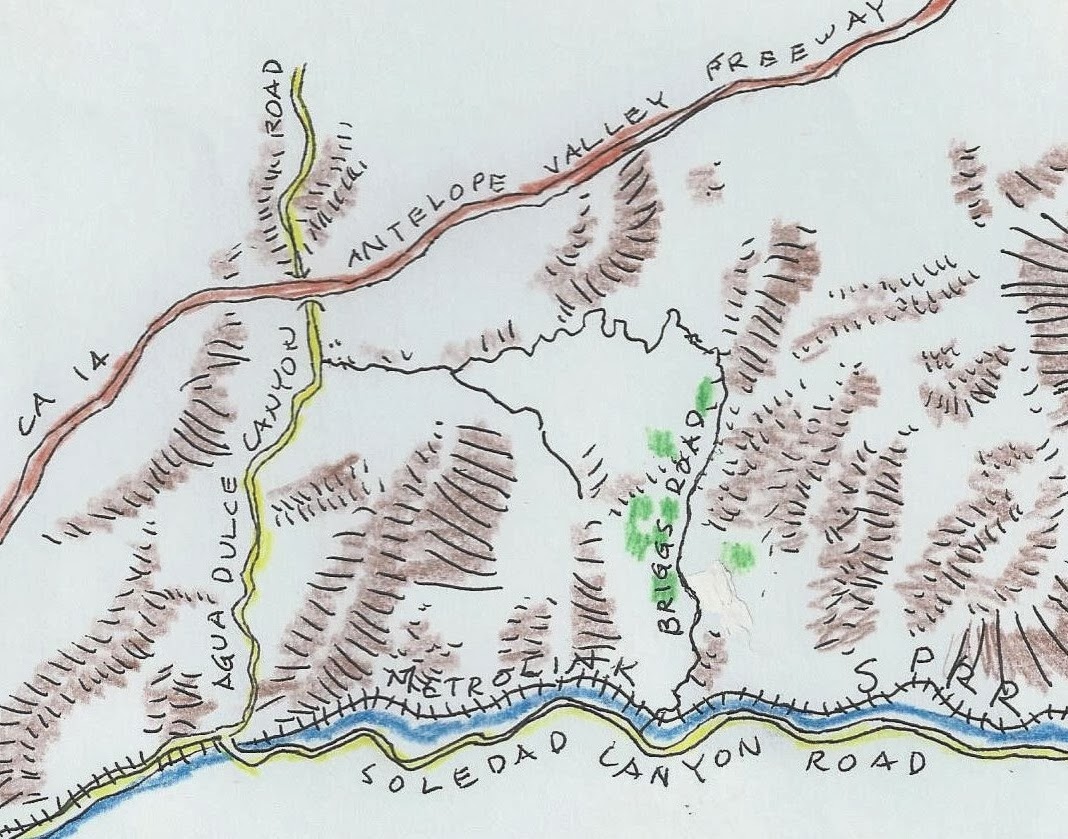
Take a look again at our non-copyright-infringing hand-drawn map—which you can verify elsewhere:


The area in which we live is a cul de sac as far as roving animals are concerned. Fleet-footed animals are hemmed in by Soledad Canyon Road and the railroad to the south, and by the California 14 freeway to the north—not by a few isolated houses. These two barriers to animal migration continue in parallel from their western point of intersection in eastern Santa Clarita (not shown) to their eastern point of conjunction east of Acton (not shown). Some animals roam freely in this area, and we do not stop them. But what, we wonder, would migrating animals do? Would they run laps from one end of this “preserve” to the other?


Antelope Valley, so named for its former occupants, is today devoid of those animals because the railroad was built through the middle of the plain and the antelope would not cross the railroad. There are no antelope in our region either. We’ve got the railroad and the freeway.

Could any public official really be so dumb as to imagine that our houses or our dirt road pose the real obstruction to these animals? And if the habitat of a smaller animal is not inhibited by the railroad or the freeway, there is obviously plenty of room for both them and us.

But is there any point to trying to persuade someone who is all heart that theirs is a flawed approach? No matter how carefully thought out, a logical argument makes no sense to some people. I’ve taught math for many years. I know there are people who just cannot think—or, more likely, refuse to make the effort.

We are appealing to your cerebral intelligence. Those of you who have a balanced intelligence will have the brains to understand what is going on, the heart to care, and the courage to do something about it—even if all that you do is post a comment here or urge others to follow this blog.

There are many hundreds of you out there—I see the numbers. But we need our oppressors to see your strength, and a simple comment “I’m on your side!” would serve that purpose.


Friday, November 8, 2013

Four Blockades

Our little Briggs Road community has two access routes to the outside world. Our primary (at least until it was blocked) route is a mile or two long dirt road that crosses the Southern Pacific Railroad, runs on existing roads through Oasis Park, a (former) trailer park/campground, and crosses the Santa Clara River over a large culvert to meet Soledad Canyon Road. The back way is a five or six mile long torturous dirt road that ends at a locked gate at Agua Dulce Canyon Road. It is a miserable, jarring drive, very slippery in the rain, always rough.

In August 2004 the residents of Briggs Road headed home to find their passage through the defunct trailer park obstructed by men who threatened to shoot them. Los Angeles County sheriffs enforced the re-opening of the passage, but when the culvert washed out in a flood the new owners of the park took advantage of the opportunity to refuse to repair the river crossing.

Many months and tens of thousands of dollars later, the courts ruled in favor of the Briggs Road community and established an easement along the existing roads in the campground/park. But in the meantime California Fish and Game prohibited the replacement of the culvert, despite the existence of many other culverts in the area. Metrolink prohibited use of the paved at-grade crossing, and threatened handcuffs and jail to those who attempted to cross. And, the coup de grĂ¢ce, Santa Monica Mountains Conservancy bought the small property at the end of the back way in a secret deal. There is no other route in or out; the terrain is too rugged. Our eleven homes are legally landlocked.

Here is a hand-sketched map of our area. The blue line is the river. Briggs Road is the thin black wiggly line. Our properties are very approximately indicated with green patches. This
is all public information, and if you wish to see a map with better detail, you should have no trouble finding one online.

When you think about the judge’s ruling for an easement by necessity through Oasis Park, you realize that if any of the other obstructing entities were private, the courts would favor an easement and allow us legal access to our homes. Instead, we are powerless against agencies of the County of Los Angeles and the State of California.

In future posts this blog will fill in many astounding details about each of the four blockades mounted against our community—none with any believable justification. We will invite you to ask your own questions of the authorities, to see if you can do any better than we have to ferret out a reasonable explanation.

Our only hope is public opinion, expressed clearly and vociferously. Our only hope is for you to participate with a note or a phone call, just as we would do the same for you if you found yourself victims of a capricious predicament. Information on how to do that is coming soon. Meantime, please comment.

And please subscribe.