Translate

Showing posts with label Santa Clara River. Show all posts

Monday, April 14, 2014

Closer?

At a community meeting with Los Angeles County officials last Friday, April 11, 2014, Briggs Road residents learned of the progress the county has made toward restoring their traditional access to Soledad Canyon Road. 

Briggs Road Community Cherishes and Maintains the Natural Terrain
But first, bottom bottom line: we are not there yet. We cannot drive any closer to Soledad Canyon Road than we could after the last meeting a month and a half ago, nor do we have an easement by the other, long and tortuous “back way.” I do apologize for starting off with this downer disclaimer, but after the last meeting newspapers and friends had the impression that we were finally freed from government forces besieging and land-locking us. That was not the case then, and it is not the case now.

On to a more positive slant—

Norm Hickling, deputy to County of Los Angeles Michael D. Antonovich, listed these encouraging developments [comments in brackets are mine]:

Mountains Recreation and Conservation Authority is now willing to give the Briggs Road Community an easement through that last parcel where “the back way” emerges onto Agua Dulce Canyon Road. [I cannot tell you what the time span is between “willing to give” and “has given.” In the opinion of this very naïve observer it should not take long at all, but in the lengthy experience of this very jaded casualty of callous government, who knows?]
  
The Dust Trap
The once celebrated straightening and shortening of the back way, such an encouraging promise eight years ago, is back on the list of possibilities. This time, though, the community will have to pay the several tens of thousands of dollars—maybe even a hundred thousand—for the grading. [Until we can do that, even with an easement at the end we still do not have a decent access for fire and emergency vehicles. However, it seems to this very naïve observer that establishing the easement, even without the new road, would go a very long way toward restoring our devastated property values.]

California Department of Fish and Wildlife and Los Angeles County engineers are working toward creating an expedient access across the Santa Clara River. [A low non-obtrusive Arizona crossing would suit the Briggs Road Community best, but Oasis Park may have commercial intentions and need a higher crossing which would cost more and possibly wash out more frequently.] Since it is the users who will bear the expense of construction, Los Angeles County counsel is fully engaged in working out how the Briggs Road Community and Oasis Park will share rights and responsibilities.

Low Crossing Would Suffice for this Typical Low Flow
We will meet again in 40 to 60 days, unless something wonderful and positive occurs, in which case Norm will contact us.

Now here is the sad part. Our trust has been badly damaged. As I have said before, I want to believe what I hear from the office of Los Angeles County Supervisor Michael Antonovich, as do most of the rest of us. And so I choose to believe that these developments are actually occurring. But my neighbors and I find ourselves unable to fully commit to believing anything any official says about our access any more. Some just don’t believe any of it. Others are compelled to append the phrase, “if they are really telling the truth,” to any discussion of what a Los Angeles County official says. This may be deserved, or it may be an artifact of government indifference and neglect. Whatever the cause, speaking only for myself, this loss of trust is very unfortunate and an additional complication we do not need.

Downtown on Briggs Road
Let us all—officials, residents, and any others involved—make a sincere effort to be worthy of trust, and to trust generously but judiciously.  


Thursday, March 20, 2014

Which Crossing is Okay?


We need a bridge!
            It’s time for another guessing game here on Save Briggs Road! Which of the river crossings shown below have escaped condemnation by the powers that be?

            All but one of the photographs below were taken in Soledad Canyon, not far from the location of our desired crossing.

      1. It is not unusual for a culvert-based crossing to wash out during a period of heavy rain. This photograph depicts the remains of such a crossing. Prior to the washout, what was the status of this crossing?


      2.  This bridge enjoys a bit of notoriety for its novel construction. It features the traditional culverts, with a garnish of railroad ties marinated in creosote. The crossing has gone the way of all such structures after a heavy storm, with the culverts slipping and rolling downriver, and the railroad ties steeping in the wet sand.


      3.  Is there such a thing as over-building a crossing?


4.  Here vehicles cross over the frothy flood via a railroad car bed. Note the safety railing at the sides.


5.  This picture was taken during construction of a culvert bridge, four days after its predecessor was wiped out. (We've been waiting almost ten years for the privilege.)


6.  Is it more environmentally sound to anchor the culverts in concrete, or is it better to allow the swollen river to push aside all obstructions? We know of a case where the river undermined a concrete barrier and left it buried forever at the river bottom.


Another View


Now for the scoring. If you judged only one of these bridges to be allowed to stand until the next flood, you get only one point, for not understanding how things work in Soledad Canyon.

In fact, however many of the bridges you judged to escape censure by the authorities, that is your score. Yes, the perfect score on our quiz is six. Not one of the photographs presented here represents a forbidden crossing.

What, then, constitutes a forbidden crossing? A crossing to be used by the residents of the Briggs Road Community is, by some strange definition, in violation of the edict set by the people-in-charge. We are not aware of any other type of crossing to run afoul of the authorities.

You may have noticed that I did not divulge the location of any of these bridges. That is because it is not our wish to have any of them or their descendants condemned. The point is this: What’s the Big Deal? If every one of these bridges is allowed to stand until Mother Nature takes it out, what is so special about a crossing accommodating the Briggs Road Community? Over the years we have cooperated in the creation of several such crossings, none worse than the worst on display here.

One last thought: Allowing the Briggs Road Community to cross the Santa Clara River benefits every single party involved in this struggle, be it a governmental agency or private interest—assuming that each is being honest about its intentions. I am not at liberty to spell out each of those benefits, but certainly there is no harm in suggesting what a bundle of good will and good press would settle on the shoulders of every involved member of Supervisor Michael D. Antonovich’s staff. 

It should be all right to point out that re-opening the much shorter access to Soledad Canyon Road takes our traffic off of the many more miles that run directly through Conservancy holdings. 

And surely there is no need to mention the importance of having a secure and reasonable access route for Briggs Road residents. That's only right.


Saturday, March 8, 2014

The Railroad Crossing, The Barricade, The River, and The Conservancy

When I wrote “Yay for LA County,” I meant "Yay" for LA County. I did not mean “Yay” for Briggs Road.

Los Angeles County officials did accomplish something difficult. I complimented and thanked them for it. Then I laid low for a while, reluctant to spoil the moment.

The difficult thing that the County of Los Angeles pulled off was to reverse an unjust policy that had stood for ten years, while saving face and allowing it to look like that accomplishment was a win for the Briggs Road community. Legitimizing the railroad crossing was not difficult. It was easy.

Friends write and ask, “Is it over at last?” No, my friends, you must read very carefully. It is not over. We could well be just the butt of a cruel joke. A month ago we were a railroad crossing, a private parcel, a river, and a piece of state land away from the legal access that even Norm Hickling says he believes is right.

Now we are a private parcel, a river, and a piece of state land away from that legal access.

We are just ten feet closer. Though legally permitted to cross the next private parcel, we are physically barred from it by a barricade we dare not touch. When we ask Los Angeles County Supervisor Michael Antonovich’s deputy, Norm Hickling, to enforce its proper removal, he changes the subject. And the barricade is still there. What a token of good faith, of truth, it would show us if that barricade were to be caused to be moved! It’s illegal, right now! Norm talks of future adjustments of our easement, but right now, now, that barricade should not be there. What is the message given by its continued existence?

We are just ten feet closer to Soledad Canyon Road. We still have to cross the Santa Clara River. Los Angeles County officials can wring their hands and plead that the river crossing is up to the State of California, but all LA County has to do is say to the State of California, “Move your arm, honey, and snuggle up closer.”

The Mighty Santa Clara River
First of all, there is extreme variability in levels of enforcement regarding disturbances of that delicate river. Stay in touch, because we’ve got some doozies for you.

Second, the State of California and the County of Los Angeles are intricately interconnected in this matter. Forgive me, but it reminds me of two malignant cancers intertwining, with disastrous consequences for the host. We have a lot for you about that, too. (If I were a conscientious office-holder in either the state or the county, I would be very worried right now that the two cancers will devastate one another. I’d ask a conscientious office-holder, if I could be convinced I had found one. I’d love to be convinced that Norm Hickling is one, but he has to prove himself. We’ve been here before, you see.)

Third, come on! Given all of the above and all the facts about the magnitude of Los Angeles County and the power of her supervisors, do any of us really believe that Los Angeles County officials have no influence over the crossing of a tiny stream? Heck, even disregarding all of the above, who in their right mind would believe that the California Department of Fish and Wildlife would ignore recommendations from a Los Angeles County Supervisor who represents two million people, in the most populous county in the nation?

Yes, now we are only ten feet closer. And at the other end of that torturous dirt track, we must pass through a parcel of land that was deeded over from Los Angeles County to another state agency for—not even a song—a gesture! More on that, too.

Beautiful, huh? Could you blame someone for wanting to steal it?

            This is going to get interesting. This current post is just the barest of outlines of things to come.

The railroad crossing is legitimized. Now for the private parcel, the river, and the state parcel.

So tell your friends to tune in and read these next blog posts. And, if you are new to this blog, please understand that this is a running story. You need to read all of it from the beginning in order to fully understand the history and the issues.

Thank you to all of you who are following: in the county, in the nation, and around the world! 

Thursday, February 13, 2014

Yay for LA County!

The railroad crossing that has been landlocking Briggs Road residents for the past ten years has been recognized by Los Angeles County as a legitimate crossing. Norm Hickling, deputy to Los Angeles County Supervisor Michael D. Antonovich, made the announcement at a community meeting in Agua Dulce Monday night, February 10, 2014.

Sunrise at the Three Sisters
It is the first encouraging move toward the result for which our community has been struggling, namely to be able to drive to our homes by a legal route of reasonable distance and construction. For a decade our path to our properties has been neither legally our own nor of a truly manageable length or condition.

Is the End in Sight?
I promised I would say it and now I will. My hat is off to you, Mr. Hickling. From where we sat it appeared that Los Angeles County was locked into a position from which it could not gracefully extricate itself. We do not know enough about the actions of other players, but Norm Hickling is exhibiting the kind of grace and sophistication that seems to elude so many public figures—and thank you for that, sir.

I want also, at this point, to give Norm all the credit he is due. And I most certainly do not want any undeserved credit given to this blog. Norm Hickling was making promising statements before I made a single post. It was his remark that he was working on the railroad crossing that first encouraged me to begin this blog. You see, we had been bitterly disappointed before, and I decided to do anything I could to prevent that from happening again. Others in the neighborhood pitched in with the same resolve.

One Giant Step for LA County
But stay with us! Things have looked almost this good before, then come to naught. And, though we are inclined to believe that this time it could actually happen, we have determined that it isn’t over until it’s over—until we are actually driving out over the lovely concrete railroad crossing and the beautiful Santa Clara River.

Our Next Hurdle: Crossing the Santa Clara River
There are kinks still to be worked out. Our drive home is not yet guaranteed. We will report on our progress as fully as we can in future posts.

Stay with us! And we love those comments! Keep ‘em coming!


Friday, November 8, 2013

Four Blockades

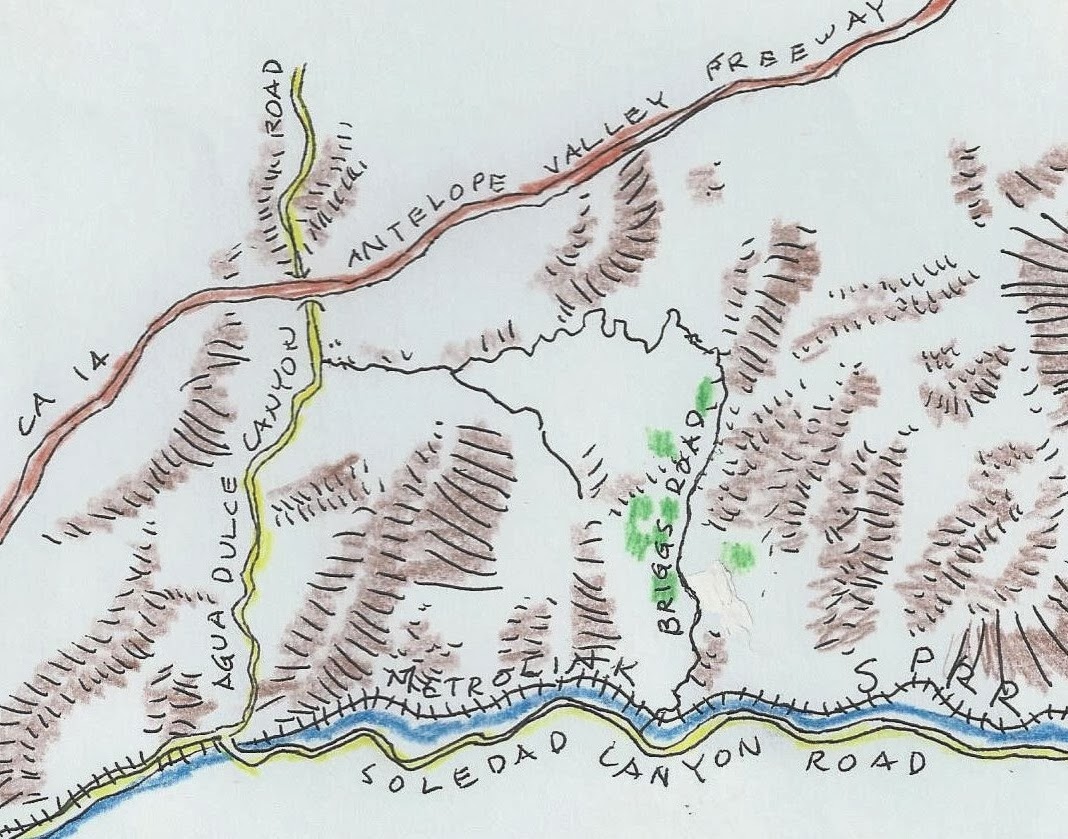
Our little Briggs Road community has two access routes to the outside world. Our primary (at least until it was blocked) route is a mile or two long dirt road that crosses the Southern Pacific Railroad, runs on existing roads through Oasis Park, a (former) trailer park/campground, and crosses the Santa Clara River over a large culvert to meet Soledad Canyon Road. The back way is a five or six mile long torturous dirt road that ends at a locked gate at Agua Dulce Canyon Road. It is a miserable, jarring drive, very slippery in the rain, always rough.

In August 2004 the residents of Briggs Road headed home to find their passage through the defunct trailer park obstructed by men who threatened to shoot them. Los Angeles County sheriffs enforced the re-opening of the passage, but when the culvert washed out in a flood the new owners of the park took advantage of the opportunity to refuse to repair the river crossing.

Many months and tens of thousands of dollars later, the courts ruled in favor of the Briggs Road community and established an easement along the existing roads in the campground/park. But in the meantime California Fish and Game prohibited the replacement of the culvert, despite the existence of many other culverts in the area. Metrolink prohibited use of the paved at-grade crossing, and threatened handcuffs and jail to those who attempted to cross. And, the coup de grâce, Santa Monica Mountains Conservancy bought the small property at the end of the back way in a secret deal. There is no other route in or out; the terrain is too rugged. Our eleven homes are legally landlocked.

Here is a hand-sketched map of our area. The blue line is the river. Briggs Road is the thin black wiggly line. Our properties are very approximately indicated with green patches. This
is all public information, and if you wish to see a map with better detail, you should have no trouble finding one online.

When you think about the judge’s ruling for an easement by necessity through Oasis Park, you realize that if any of the other obstructing entities were private, the courts would favor an easement and allow us legal access to our homes. Instead, we are powerless against agencies of the County of Los Angeles and the State of California.

In future posts this blog will fill in many astounding details about each of the four blockades mounted against our community—none with any believable justification. We will invite you to ask your own questions of the authorities, to see if you can do any better than we have to ferret out a reasonable explanation.

Our only hope is public opinion, expressed clearly and vociferously. Our only hope is for you to participate with a note or a phone call, just as we would do the same for you if you found yourself victims of a capricious predicament. Information on how to do that is coming soon. Meantime, please comment.

And please subscribe.